
Maybe you are tired of being told to “just let it go.”

You know the past is over. You know you are safe now. You know this person is not your parent, your ex, your abuser, or whoever hurt you.
And yet your body does not always seem to know that.
A tone changes. Someone looks disappointed. A text goes unanswered. You make a mistake. Someone raises their voice.
And suddenly your heart is pounding, your stomach drops, your thoughts are racing, or you are trying desperately to figure out what you did wrong.
Or maybe you go in the opposite direction.
You shut down. You feel numb. You cannot find your words. You leave the room mentally even though your body is still sitting there.
Later, you may look back and think:
Why did I react like that? Why does this affect me so much? Why can’t I just move on?
Because sometimes the past does not stay neatly in the past.
Trauma Doesn’t Always Look Like Trauma
Maybe you have a story that clearly feels traumatic.
An assault. An accident. A frightening medical experience. A traumatic birth. Violence. A sudden loss.
Something happened, and you know it changed you. 
But maybe your story is harder to name.
Maybe nothing in your childhood looked “bad enough” from the outside. You had food. You had a home. Maybe your parents loved you.
And yet you learned to watch people carefully.
You learned who was in a good mood and who was not. You learned when to stay quiet. You learned how to be helpful, agreeable, funny, invisible, independent, or perfect.
You learned how not to need too much.
Sometimes trauma is what happened. Sometimes it is what happened over and over.
And sometimes it is what you needed and never received.
When Your Body Is Always Waiting for Something to Go Wrong
Maybe you are the person who notices everything.
A shift in someone’s voice. A facial expression. A pause in a text. A door closing harder than usual.
You can walk into a room and know immediately that something is off.
That ability may look like intuition. And sometimes it is.
But sometimes it is a nervous system that became very good at scanning for danger.
You may be exhausted from always anticipating, always preparing, always trying to stay one step ahead.
Maybe you replay conversations for hours. Maybe conflict makes you physically sick. Maybe someone being disappointed in you feels almost unbearable.
Maybe you cannot fully relax even when nothing is wrong.
Your body may still be protecting you from something that is no longer happening.
One way we make sense of this in therapy is through the Window of Tolerance—the range in which your nervous system feels regulated enough for you to stay present, think clearly, feel your emotions, and respond with choice.
When something pushes you outside that window, your system may move up into activation—anxiety, panic, anger, racing thoughts, hypervigilance—or down into shutdown—numbness, fogginess, disconnection, exhaustion, or dissociation.
Neither response means you are failing. Your nervous system is trying to protect you.
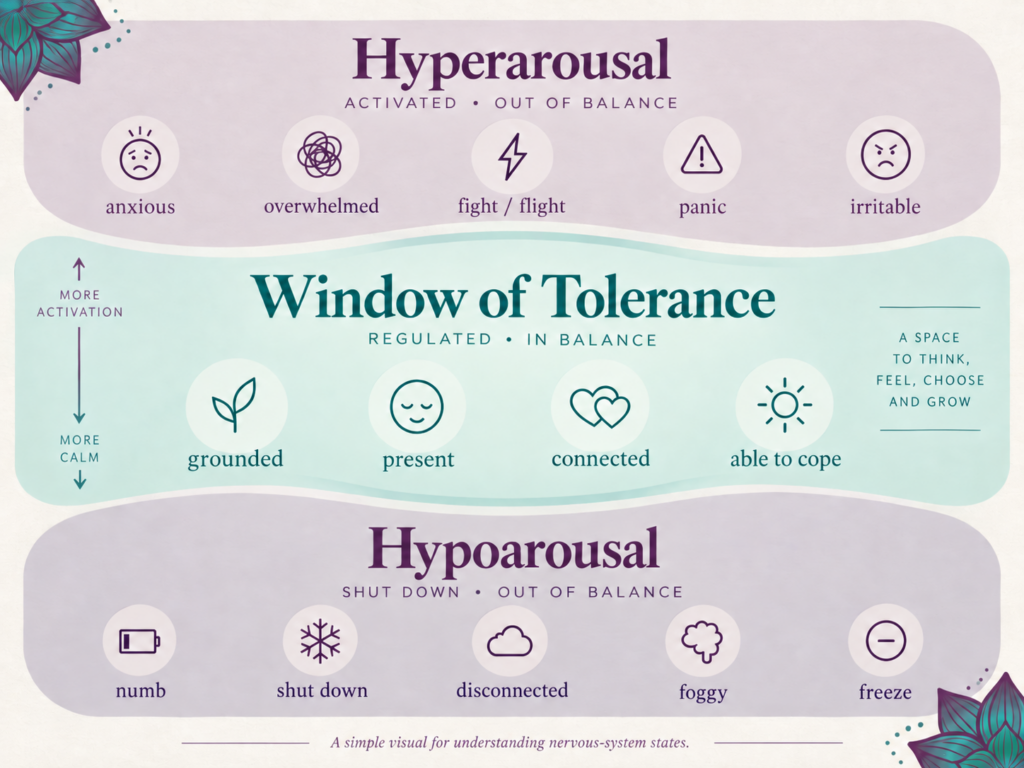
Your window is not fixed. With support and practice, you can become better able to recognize these shifts, return to regulation, and have more choice in what happens next.
Complex Trauma Can Hide Behind Intelligence
You may be incredibly capable.
People may describe you as strong, independent, responsible, or resilient.
You get things done. You handle crises. You take care of yourself. You take care of everyone else.
And underneath all of that competence, you may be carrying a belief that says:
I can only depend on myself.
Or:
If I need too much, people will leave.
Or:
If I keep everyone happy, I’ll be safe.
Complex trauma often does not announce itself dramatically.
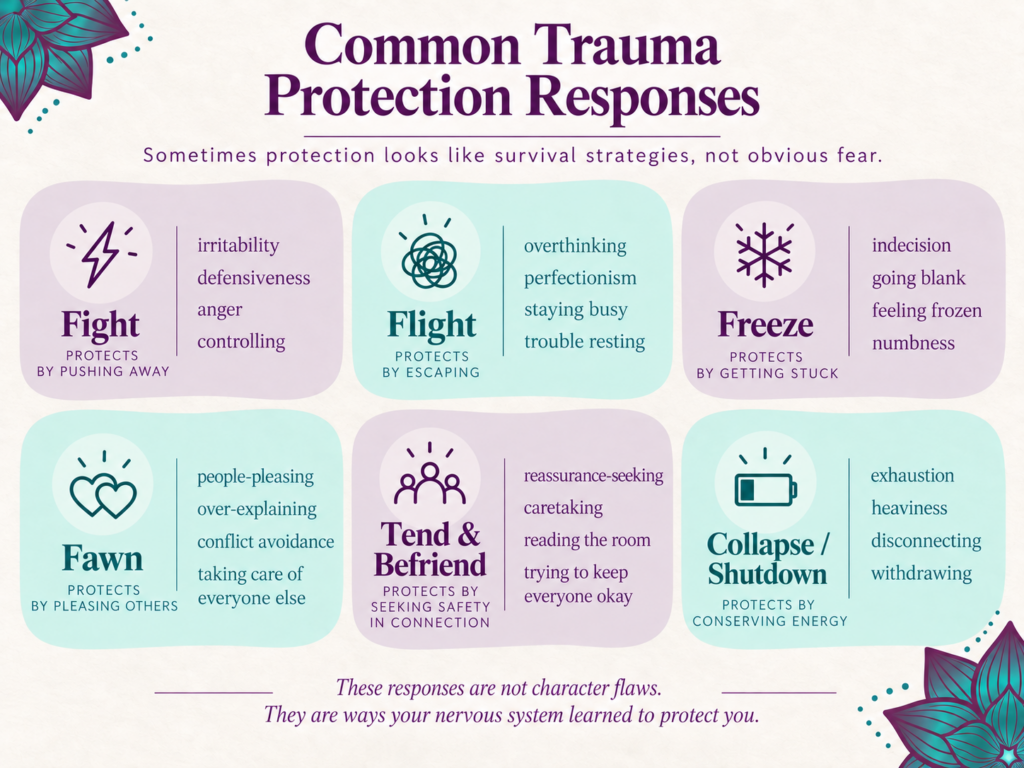
Sometimes it looks like overfunctioning, people-pleasing, perfectionism, difficulty trusting, staying too long in relationships that hurt, or pulling away when someone gets too close.
You may know exactly what the pattern is and still find yourself caught inside it.
That is one of the frustrating things about complex trauma:
Insight can explain the pattern without necessarily changing the reaction.
Sometimes the Safest Thing Was to Disappear
Maybe you do not always feel anxious.
Sometimes you feel nothing.
You go blank. You lose time. You stop feeling connected to your body. You hear someone talking and realize you have not absorbed a word they said.
You may describe yourself as foggy, detached, numb, or “not really here.”
Or maybe you stay constantly busy so you never have to slow down enough to feel.
Work. Scrolling. Food. Planning. Cleaning. Overthinking. Fantasy.
Anything that keeps you moving.
Dissociation is not weakness.
For many people, it began as protection.
When fighting back was not possible, when leaving was not possible, or when being fully present was simply too much, your system found another way to get you through.
We do not need to rip that protection away.
We become curious about why it developed—and whether you still need it in the same way now.
Your nervous system may have learned more than one way to protect you. What can look confusing, frustrating, or extreme on the outside often makes more sense when you understand it as protection.
The Frustrating Part- You May Already Understand All of This
This is where people often get stuck.
You know why you people-please.
You know where your fear of conflict comes from.
You know your attachment style.
You can explain your childhood.
You have read the books.
You have listened to the podcasts.
Maybe you have spent years in therapy.
You understand yourself.
And then someone looks disappointed in you and suddenly every ounce of insight disappears.
Your body reacts before your thinking brain can catch up.
That does not mean the work you have already done failed.
It may simply mean that insight is not the whole job.
Trauma Therapy Can Go Deeper Than Talking About What Happened
You do not have to spend session after session retelling every painful detail of your life.
Sometimes the work is about noticing what happens now.
What happens inside you when someone says no?
When you feel ignored?
When you make a mistake?
When you want to set a boundary?
When someone gets too close?
When someone pulls away?
We may work with the beliefs, protective parts, body responses, relationship patterns, and old alarm systems that continue to shape those moments.
Depending on your therapist and what fits you, that may include EMDR, parts work, relational therapy, nervous-system-informed approaches, cognitive strategies, and practicing new responses outside the therapy room.
There is no single formula.
More Freedom in the Present
The goal is more freedom.
More room between what happens and what you do next.
More ability to recognize, This feels familiar, but it is not the same.
More trust in yourself.
More choice.
You do not have to erase the past.
You may simply need the past to stop deciding so much of your present.
See Dr. Nadine Burke Harris's TED Talk about how childhood trauma affects health across a lifetime
See Dr. Hannah Stratford talk about the causes and treatment of PTSD