
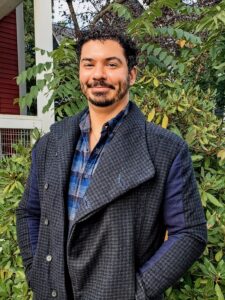
Brett Sinclair, LLMSW
You do not need to mask or arrive with all the answers
I am Brett Sinclair (he/him), an outpatient therapist with The Nurturing Space Counseling. I work with adolescents and adults in person in Traverse City and through
telehealth across Michigan.
Many of the people I work with appear capable on the outside while carrying exhaustion, burnout, anxiety, grief, or a sense of disconnection internally. I especially enjoy working with neurodivergent clients, including people with ADHD and Autism, as well as individuals navigating complex grief, identity exploration, life transitions, and chronic anxiety.
How I understand distress
I do not see suffering as evidence that something is inherently wrong with you.
Often, distress develops in the space between who you are, what your nervous system
needs, what you have lived through, and the environments you have had to adapt to.
I sometimes think of this as a kind of systemic collision—the friction that can occur when your need for safety, connection, authenticity, or belonging meets overwhelming
circumstances or structural pressures.
My goal is not to strip away the strategies that helped you survive. It is to understand them, honor what they have done for you, and help you develop greater flexibility and
choice moving forward.
How I work
My approach is grounded in somatic and Polyvagal-informed care and influenced by Acceptance and Commitment Therapy (ACT), Internal Family Systems (IFS)/parts work, and Solution-Focused Therapy. I often think about therapy in three overlapping movements:
Regulate and stabilize. We begin by strengthening safety and helping you better understand your nervous system, including how your body responds to stress, threat, and overwhelm.
Reflect and make meaning. We explore patterns, beliefs, internal conflicts, and the parts of you that may carry fear, shame, pressure, or self-criticism.
Act with intention. We work toward practical changes that align more closely with your values, identity, relationships, and the life you want to build.
I tend to take a “teacher first, then anchor” stance. At times, that means offering education and helping you make sense of what is happening. At other times, it means
simply being steady and present while you move through something difficult.
Grief, transition, and belonging
Grief is one of the areas I feel especially drawn to.
Loss can involve much more than death. It may include the loss of a relationship, a role, a future you expected, a sense of safety, a version of yourself, or a place where you once felt you belonged.
I sometimes use the term “Griefwright” to describe the way I think about this work: walking alongside people as they make meaning from loss and begin rebuilding a life that can hold both what was lost and what still remains possible.
I also care deeply about helping my clients experience a stronger sense of belonging and self-authorship. That may mean understanding yourself outside of expectations that never fit, developing a more compassionate relationship with your neurodivergence, or making choices that feel more aligned with who you actually are.
What I hope you gain from therapy
My hope is that therapy helps you feel more grounded, more able to understand your own responses, and more confident in making choices that reflect your values.
You should not have to become less yourself in order to function better in the world.
The goal is greater safety, flexibility, connection, and the freedom to live with more
authenticity and intention.
Brett is able to bill Priority Health, Forest County Potawatomi, Aetna, Cofinity, Meritain, Luminaire and McLaren commercial Health Insurance Plans. He can accept BCBS for short term- therapy (until March 1, 2027).